BODWELL’S BAKER’S DOZEN 2025
Why a “baker’s dozen” of books rather than the conventional “Top Ten” list? It’s simple: back in 2009 I couldn’t manage to cut three books I really admired from my list—or to be more precise, I didn’t want to cut three books just to fit some arbitrary constraint.
In addition, I immediately decided that even though most year-end roundups focus on titles published during the year the list was written, my lists would be less didactic and more of an authentic representation of a real reading life: We are both always behind and always discovering. Before 2016, for instance, I’d never read Penelope Fitzgerald’s perfect short novel The Bookshop. Even though the book was first published in 1978, I had to include it on my 2016 list. It was, after all, new to me.
Finally, my aim was never to synopsize or review the books on my list, as is often the norm for annual lists, but to contextualize the books within my life, to note how I’d come to read the book or why I’d been moved to include it on my list.
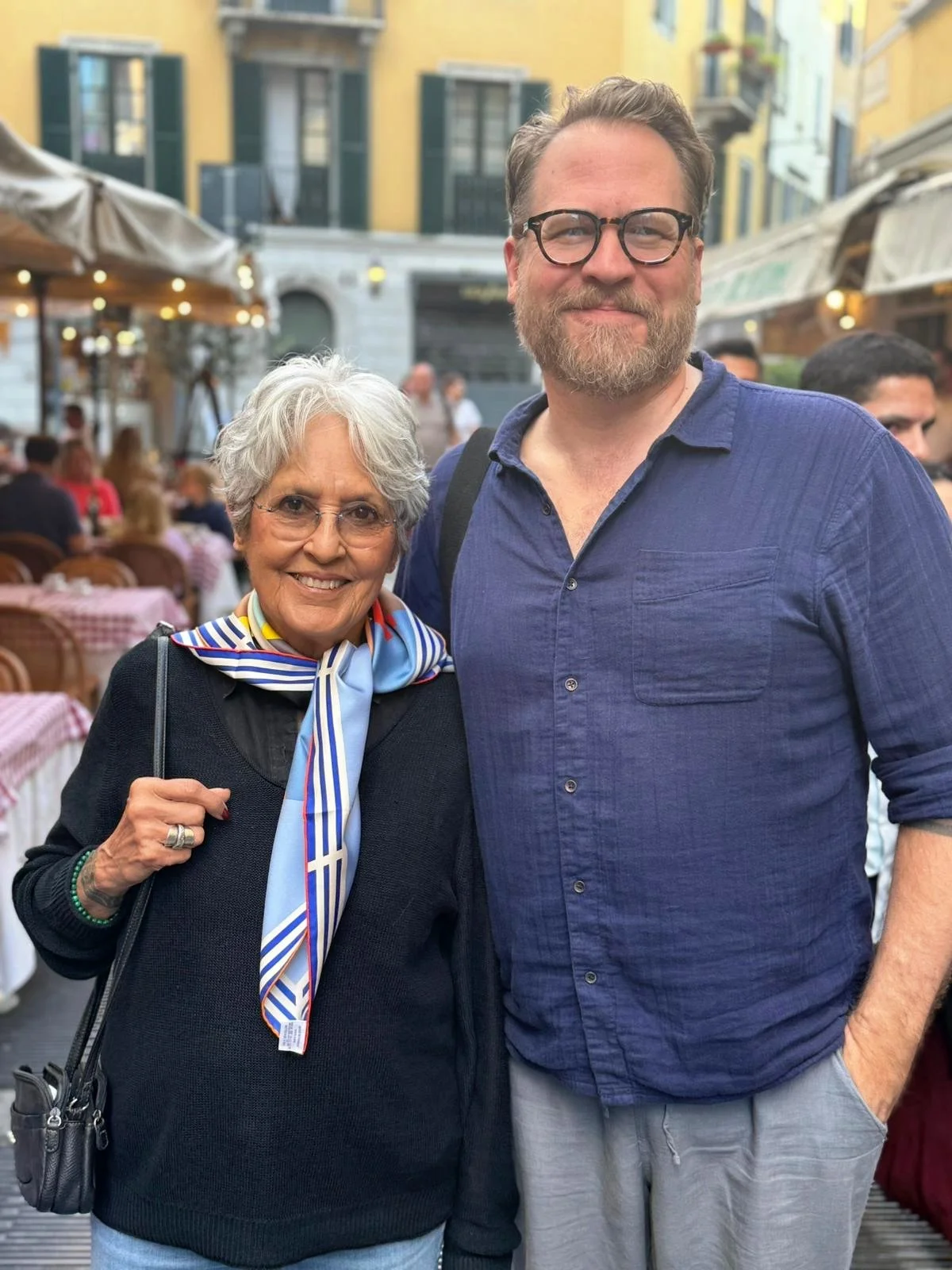
(PHOTO: The author of Bodwell’s Baker’s Dozen on book tour in Milan, Italy with Joan Baez.)
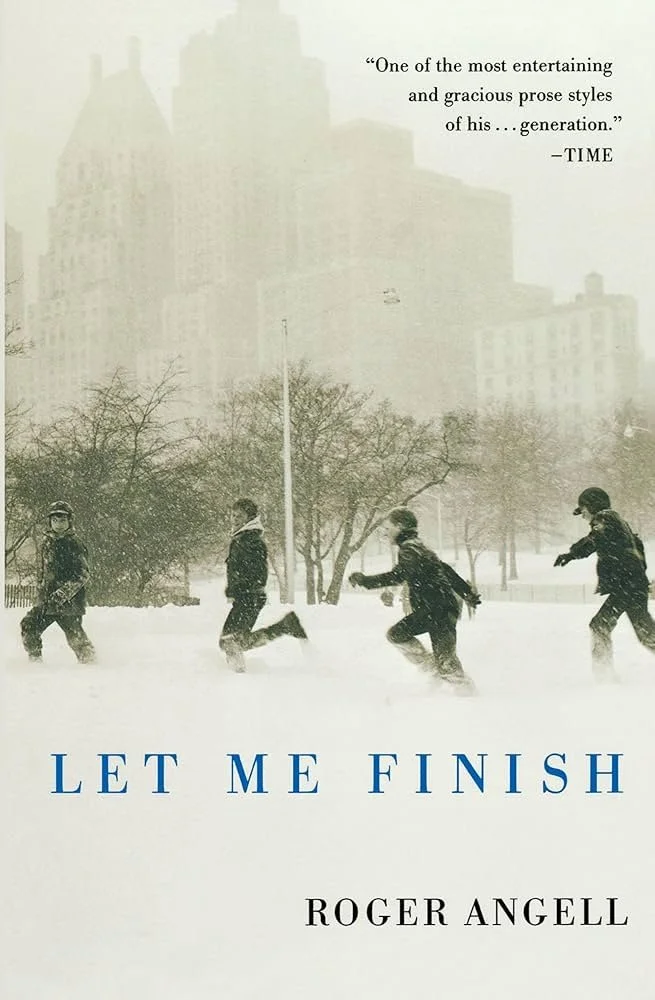
LET ME FINISH
Roger Angell
Longtime New Yorker fiction editor and bard of baseball Roger Angell has a gift for charming the reader in this wonderfully loose-limbed memoir. The son of Katharine White and the stepson of E. B. White, Angell admits his has been “a life sheltered by privilege and engrossing work, and shot through with good luck.” Yet, rather hold this truth jealously against him, we’re enamored. Angell, who died in 2022 at the age of 101, found his longevity gifted him complex years of reflection: “We should probably all pause to confront our past from time to time, because it changes its meaning as our circumstances alter.”
“If Andy White could be with us today he would not be with us today.”
(remarks at E.B. White’s funeral)
(Houghton Mifflin Harcourt, 2006)
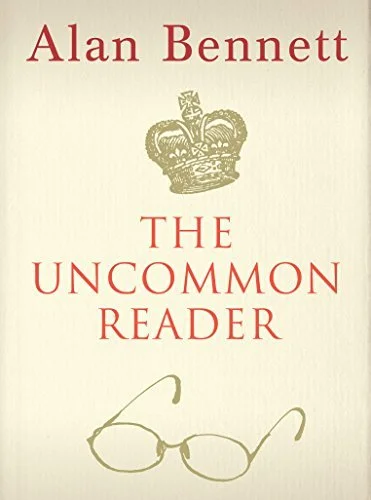
THE UNCOMMON READER
Alan Bennett
One doesn’t want to feel one is being hyperbolic, but one can’t resist calling this novella utterly captivating and the sort of thing that makes one smile and giggle a bit as one reads. What begins with the Queen of England chasing her errant corgis and stumbling upon a bookmobile parked near the kitchen delivery doors of Buckingham Palace turns into a mediation on the reading life—as well as power, loneliness, expectations, assumptions, misperceptions, and…well, life in general. Bennett’s pointed wit is not barbed, but it is laser sharp.
“What she was finding also was how one book led to another, doors kept opening wherever she turned and the days weren’t long enough for the reading she wanted to do.”
(Faber & Faber and Profile Books, 2007)
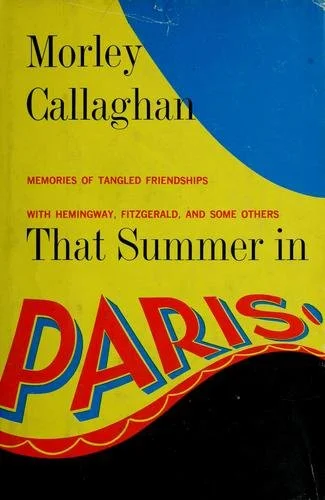
THAT SUMMER IN PARIS
Morley Callaghan
The Canadian short story writer and novelist Morley Callaghan is today mostly remembered in the many biographies of Ernest Hemingway: while sparring for exercise in Paris, Callaghan knocked Papa to the ground (F. Scott Fitzgerald acting as timekeeper). But Callaghan was more than a footnote of literature: he eventually published thirteen novels and five short story collections, was compared to Chekhov and Turgenev, made a Companion of the Order of Canada, and immortalized on a Canadian postage stamp.
In the summer of 1929, when Callaghan was twenty-six and had published his first book with Scribner’s, he and his wife traveled to Paris. Callaghan’s memoir of that summer, written when he was nearly sixty, is neither falsely modest nor casually egotistical. It is reflective and searching, the work of an old journalist hoping to understand how it was.
“His manner was correctly courteous. All the little gentlemanly amenities seemed to be important to him. There was nothing lazy or slovenly about his speech or his movements. His light brown hair was cut cleanly and combed exactly, and he spoke with a quiet precise firmness. He was slender and of medium height. In the cut of his jaw, in his little gestures, there was a forcefulness, almost a sense of authority. Perhaps it was the manner of a man who knew he should always appear in this light; yet he did seem to assert a deep confidence in his own importance. It was attractive and somehow reassuring. Later on it came out that this sense of his importance both sustained and tormented him.” (on F. Scott Fitzgerald)
(Coward-McCann, 1963)
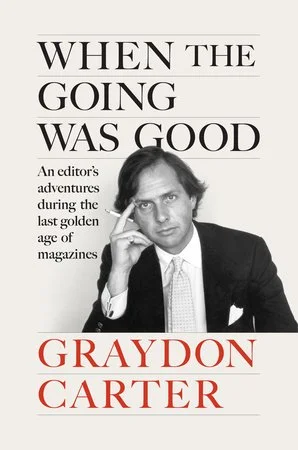
WHEN THE GOING WAS GOOD
An Editor’s Adventures During the Last Golden Age of Magazines
Graydon Carter
Between 2002 and 2008, my book-reading quota dropped because I spent a chunk of each month reading Vanity Fair nearly cover to cover.
The issues were thick with easily 120+ pages of editorial. There was a monthly dose of Christopher Hitchens, as well as staggeringly good longform journalism by Sebastian Junger, Michael Lewis, and Marie Brenner, whose Vanity Fair stories became the movies “The Insider” by Michael Mann (1999) and “Richard Jewell” by Clint Eastwood (2019).
Carter’s crisp memoir of (mostly) his years at the helm of Vanity Fair (1992 to 2017) is a master class of self-deprecation. But it’s clear, too, how hard he worked to make it all appear effortless. What always appealed to me about Carter, I think, was that he seemed to be a puckish peasant who’d somehow scaled the castle walls and stolen the throne. Also: at his short-lived but explosive magazine Spy, it was Carter who first noted the diminutive size of Trump’s hands and labeled him a “short-fingered vulgarian.”
“It’s not so much what you say yes to in life as what you say no to.”
(Penguin Press, 2025)
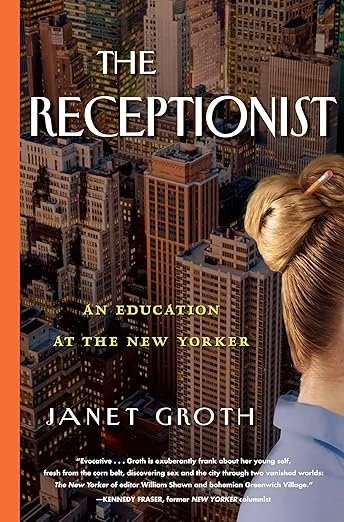
THE RECEPTIONIST
An Education at The New Yorker
Janet Groth
In 1957, twenty-one year old Janet Groth landed a job as a receptionist at The New Yorker after being interviewed by a shy E. B. White. The Receptionist is her memoir of how an Iowa-born Lutheran virgin navigated New York City in the Sixties. Between 1957 and 1978, Groth received a marriage proposal from the poet John Berryman, lunched most every week with Joseph Mitchell, and moonlighted as Muriel Spark’s personal secretary. Though she struggled with doubt and a sense of inadequacy about her writing, Groth’s memoir is clear-eyed and charming.
“We are all of us searching for a perfect family. Sometimes we substitute material things, but often in the friendships we form, the lovers we take, the mates we marry, we are arranging for ourselves the understanding mother, the good father, the loving brother and sister we yearn for, the things we missed in our own.”
(Algonquin Books, 2012)
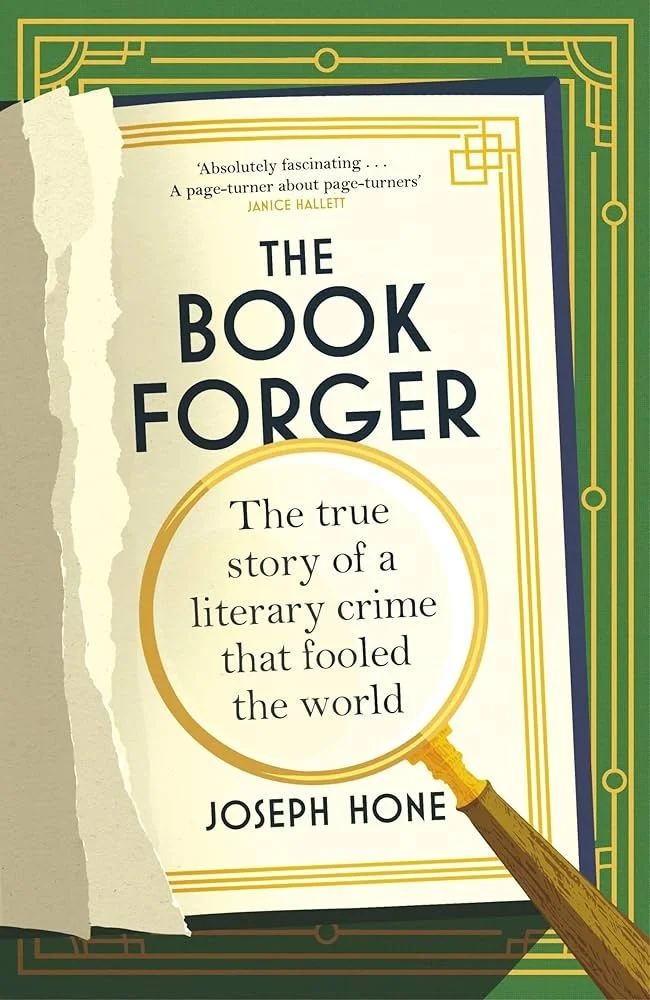
THE BOOK FORGER
The True Story of a Literary Crime that Fooled the World
Joseph Hone
When my wife and I stayed in Wigtown, Scotland with Shaun Bythell at The Bookshop for a few days of our honeymoon, Shaun pressed a galley of Joseph Hone’s The Book Forger into my hands.
In early 1900s London, Thomas James Wise—book collector, bibliographer, and all around bibliophile—was the toast of the literary community. He was also a liar and thief. The Book Forger recounts how two young booksellers—a disheveled, half-hearted communist and a martini-swilling fan of detective stories—brought Wise’s crimes to light. Much to my delight, one crucial clue involved not just a specific typeface, but a specific element of a specific typeface: ligatures.
Much has been written about Wise over the years, but Hone’s telling is a page-turner. Wise was the sort of person who came from modest means but became pompous and bullying as he rose to prominence—reading how two dogged bookseller-heroes dismantled him is oh so satisfying.
(Chatto & Windus, 2024)
MICHAEL McLAVERTY: EIGHT NOVELS
Between February and October of this year, I read all eight novels Irish author Michael McLaverty published between 1939 and 1965. I won’t even attempt to rank them and select a favorite. Instead, I am putting all eight novels on my list. I loved every single one of them.
McLaverty has been a revelation to me (I’m grateful to my friend Simon for getting me started with the gift of The Choice.) McLaverty’s novels are so calm, yet somehow riveting. A devotee of Chekhov, he patiently accrues emotion. In McLaverty’s work there is no shortage of hardship and loss, unrequited love, misunderstanding, guilt and shame—and yet his novels brim with innate goodness.
Though McLaverty lived until 1992, he did not publish another novel after 1965. By this time he was, wrote a scholar of his work, “sadly resigned to the fact that the world had grown strange to him.”
Call My Brother Back (1939)
Lost Fields (1941)
In This Thy Day (1945)
The Three Brothers (1948)
Truth in the Night (1951)
School for Hope (1954)
The Choice (1958)
The Brightening Day (1965)
“It’s strange how ugly things stick in our minds and how easily we forget things that are beautiful.” (from The Choice)
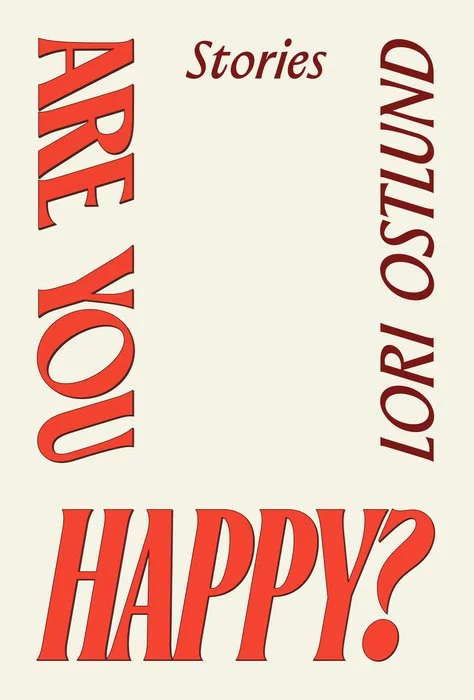
ARE YOU HAPPY?
Lori Ostlund
After reading Lori Ostlund’s debut novel (After the Parade) a decade ago, I wrote that she had a gift for infusing nearly unbearable sorrow with laugh out loud humor. Here in her second short story collection, Ostlund’s gifts are in peak form. An example: In “Clear as Cake,” a narrator whose life has taken surprising turns attends an evening writing class for adults at a university in Minnesota. The pipe-smoking professor, Marvin Helgarson, calls writers “liars and thieves” and the attendees are a loveable mix of oddballs and eccentrics. One woman is upset when the professor says a two-page she’s brought to class is more an anecdote than a short story. Ostlund writes:
“She snorted. ‘Anecdote.’ Then, she walked out. It was late, nearly nine o’clock, and we could hear her footsteps echoing, not only because the building was empty but because she was wearing ski boots.”
Ostlund sets most of her stories across Minnesota (where she grew up), New Mexico (where she lived for years), and California (where she lives now), and most of her wonderfully digressive narratives feature queer characters. But because Ostlund is so big-hearted and so talented, these are not stories boxed in or defined by geography or sexual identity, these are stories about what it means to be human and attempt to understand other humans—and yourself.
(Astra, 2025)
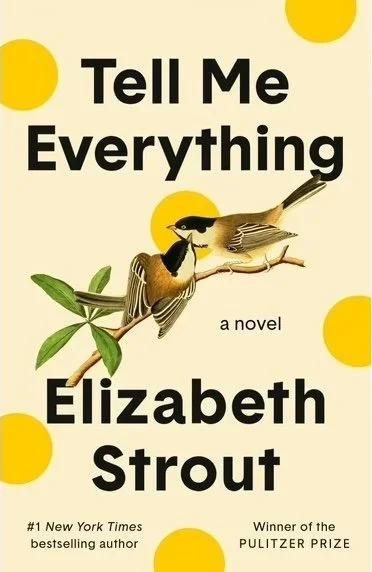
TELL ME EVERYTHING
Elizabeth Strout
Olive Kitteridge! Lucy Barton! Bob Burgess! All in one book! Oh! I sort of marvel at the folksy charm with which Elizabeth Strout’s characters navigate grief and sadness, friendship and love.
“People did not care, except for maybe one minute. It was not their fault, most just could not really care past their own experiences.”
(Random House, 2024)
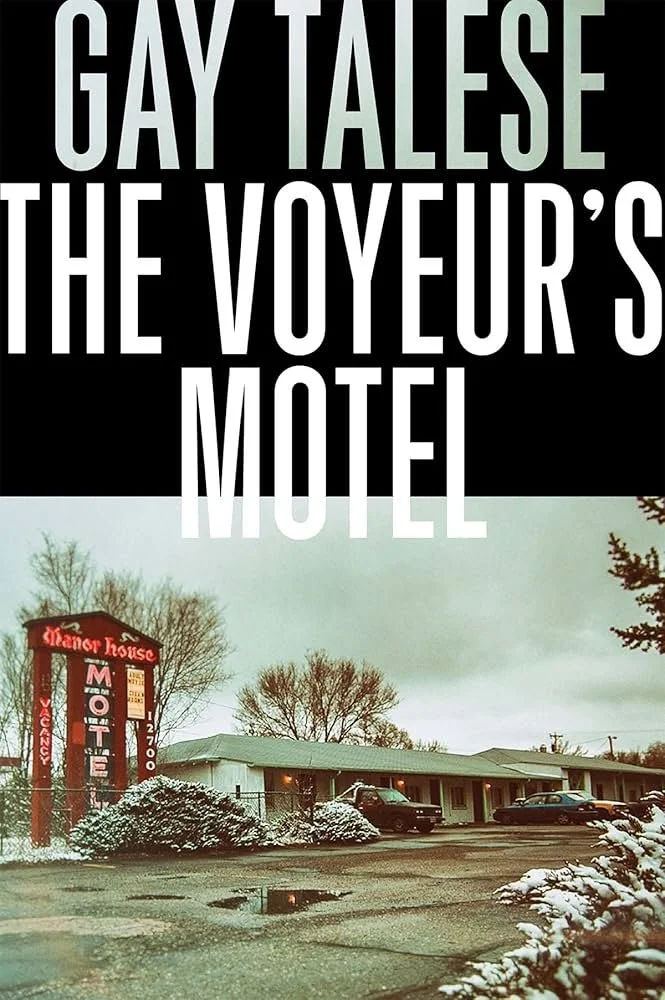
THE VOYEUR’S MOTEL
Gay Talese
Early in the year, I read an expanded edition of Gay Talese’s 1960s masterpiece The Bridge. Then I read his latest, Bartleby and Me. And then I read The Voyeur’s Motel.
Gerald Foos was the owner of a 21-room motel in suburban Denver. He began spying down on his guests through 6-by-14-inch surveillance ceiling grates he installed in the late 1960s. Foos’s journal entries about what he peeped for decades are featured throughout the book. It is through these journal entries, sometimes written by Foos in the third-person, that we see what Talese knows: Foos is an unreliable voyeur. Foos’s shocking-at-first descriptions of sex quickly become sexless, banal. He comes across as emotionally stunted, perpetually the immature young boy who used to spy on his topless aunt in her neighboring farmhouse.
The Voyeur’s Motel is thorny. It made me uncomfortable, left me disgusted at times and. in the end, sad. But I say this as a compliment. I appreciate ethically complex.
“I know a married man with two children who bought a twenty-one-room motel near Denver many years ago in order to become its resident voyeur.”
(Grove Press, 2016)
ABOUT ALICE
Calvin Trillin
There was a moment while reading Calvin Trillin’s glorious short celebration of his wife Alice when I accidentally thought, “Oh, I would love to write this sort of celebration of my generous and complex wife.” I say accidentally because, of course, Trillin’s slim masterpiece of restrained grief was written five years after his wife’s death. I feel both terribly guilty and utterly relieved that my wife Tam will most likely outlive me. So, alas, I am putting aside all plans for my own book, Totally Tamsyn.
“For Alice, of course, the measure of how you held up in the face of a life-threatening illness was not how much you changed but how much you stayed the same, in control of your own identity.”
*I also read Trillin’s Messages From My Father this year and loved it.
(Random House, 2006)
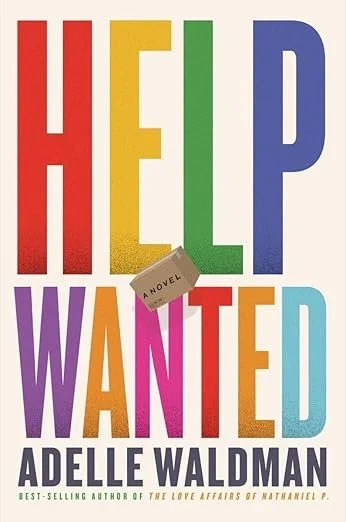
HELP WANTED
Adelle Waldman
This surprisingly swiftly paced novel follows a group of low-wage part-time employees at a Target-like big box store. Adelle Waldman’s omniscient narrator moves effortlessly amongst the team known as Movement, employees who report to work every day at 3:55 a.m. to unload pallets of merchandise and restock shelves. My favorite parts were those rooted in describing the inanely mundane aspects of being a low-wage worker, those that echo the narrative nonfiction of, say, Barbara Ehrenreich’s Nickel and Dimed.
Strangely, many reviewers have called the book “slyly comic” or “darkly funny” or “very funny” or (the publisher themselves) simply “funny.” I’ve worked second-shift jobs in factories, experienced the loneliness and meanness of those jobs. There is a surrealness to such jobs, sure, but “funny”? “Desperation” is the more common dominator. Help Wanted is at its best as a social and political novel when that desperation is centered.
“These days, Potterstown was as much museum as city, its past glory evident less in its people—many of whom walked around with something of a shell-shocked look, as if modernity itself had caught them unawares—than in the fine old buildings that had outlived the purposes for which they’d been built.”
(W. W. Norton & Company, 2024)
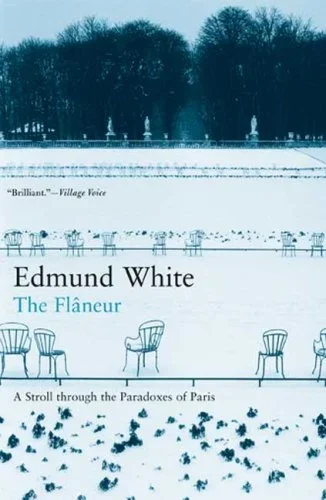
THE FLANEUR
A Stroll Through the Paradoxes of Paris
Edmund White
A flâneur is not simply a stroller, but one who ambles along without apparent purpose (what my great uncle lovingly called a lollygagger), and one who is actually calmly attuned to the place and open to wherever fate or opportunity leads. This is how I (and, blessedly, my wife) love to travel, and it is how Edmund White, who moved to Paris in 1983 (a year after the publication of his breakout novel A Boy’s Own Story) experienced the City of Lights.
Originally published as part of Bloomsbury’s Writer and the City series, The Flâneur ricochets around Paris in utterly captivating ways. White is a disarmingly charming yet commanding guide—he is not French, but he is the award-winning author beloved biographies of Proust and Genet who the French government named a Chevalier (and later Officier) de l’Ordre des Arts et des Lettres.
I read The Flâneur shortly before I visited Paris in 2025 for the first time. Each time I rode a bike around the city, an observation White drove home was perpetually on my mind : the magisterial Paris we marvel over today—the Paris so many readers imagining American expatriates of the Lost Generation—is not Baudelaire’s “cozy, dirty, mysterious” Paris, but a new Paris, the result of a massive urban renewal plan begun in 1853. A flâneur’s eye searches beneath the surface.
(Bloomsbury, 2001)
BONUS READING!
Favorite Re-Reads
So Long, See You Tomorrow William Maxwell
(Knopf, 1980)
Women with Men Richard Ford
(Knopf, 1997)
Great Shorts
It’s tricky to keep track of the loads of great short stories and essays I read in magazines and literary journals over any given year, but I found unforgettable this one unforgettable:
“Cather and the Academy” by Joan Acocella (The New Yorker, November 27, 1995)
“A Room of Their Own” by Ann Beattie (The American Scholar, Autumn 2025)
“Unshaken Friend” by Malcolm Cowley (The New Yorker, April 1, 1944)
“August Blue” by Guy Davenport (from A Table of Green Fields)
“Edna O’Brien Is Still Writing About Women on the Run” by Ian Parker (The New Yorker, October 7, 2019)
“Paint it Black” by Lincoln Perry (The American Scholar, Autumn 2025)
“Twain Dreams” by John Jeremiah Sullivan (Harper’s, June 2025)
“The Lonely Fate of Typhoid Mary” by Stanely Walker (The New Yorker, January 18, 1935)
“One Four Two Five Old Sunset Trail: On the last days of Gene Hackman” by Joy Williams (Harper’s, November 2025)
“Second and Long” by Steve Yarbrough (The American Scholar, Autumn 2025)